
Laser Wart Removal
Laser removal of age warts
Why do warts recur so often, and what can be done?
They are viruses, they recur because they get inside cells that do not see them as bad and allow them to encode a rather disorganized acceleration process. They can be in apparently healthy tissues. The fact that they have very good boundaries is an indication that the body is defending itself against them to some extent, but it is also a fact that they will not leave the cells they infiltrated unless the group of affected cells no longer serves as a host for new colonizations.
That is why all home and medical remedies involve destroying as much affected tissue as possible as an initial step; however, the body identifies the viruses and does not let them colonize more cells. All home and non-home remedies involve inflammation of the site where the warts are lodged.
Some flourish in patients undergoing chemotherapy, which, upon finishing it and recovering the body’s defenses, disappears. This is why the only way to remove them is to perform checks before the lesions appear again and repeat the procedure at the slightest suspicion of recurrence until, with all the inflammation produced, the body learns to close the door to the viruses.

La remoción debe incluir un pequeño margen lateral y un plano de profundidad hasta la dermis
La remoción debe incluir un pequeño margen lateral y un plano de profundidad hasta la dermis
Treatment sequence on a toe.
How are facial warts removed?
Tissue preservation is mandatory for this type of lesion, which by definition is superficial and numerous. The laser evaporates the lesion layer by layer to avoid damaging the healthy skin of the face.
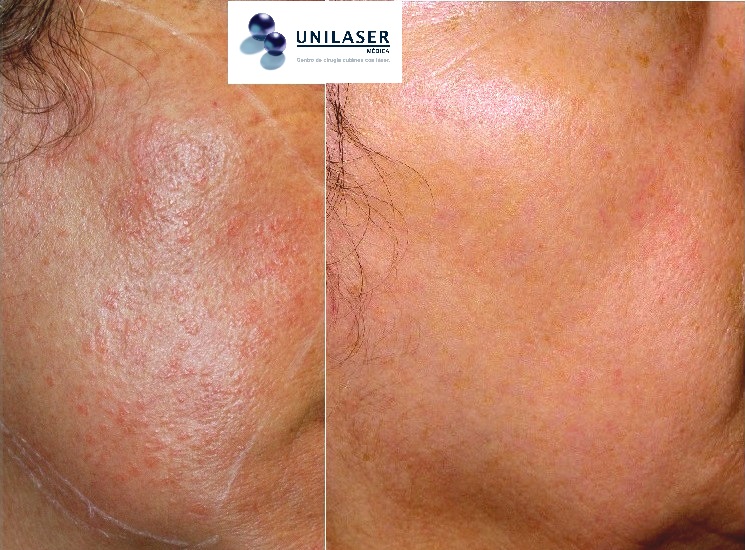
Resultado de evaporación con láser Erbio-YAG de múltiples verrugas planas de la cara
Erbium-YAG laser evaporation result of multiple flat warts of the face
Erbium-YAG laser evaporation result of multiple flat warts of the face.
How are warts on the fingers/toes removed?
It is only possible to eliminate them when all affected tissue is removed or when the body learns to control them. Laser evaporation is the best technique, because involvement of the matrix is a frequent complication and it is temporary as long as it is not total damage; it recovers.

El aspecto de carbonización de los disparos es un efecto típico del láser de CO2 , la onda de calor generado afectó la matriz que se refleja en el crecimiento disforme de la uña. Afortunadamente la matriz recuperó su función y a la altura del mes 7 no presentaba alteraciones
The carbonization aspect of the shots is a typical effect of the CO2 laser, the heat wave generated affected the matrix that is reflected in the disform growth of the nail. Fortunately, the womb recovered its function and at month 7 there were no changes.
The heat wave generated affected the matrix, which is reflected in the deformed growth of the nail. Fortunately, the matrix recovered its function.
Do scars remain after removing a wart?
There shouldn’t be any because in early stages it is superficial and remains so in areas like the face. Scars happen when the lesion is extensive or deep. With laser in a very large lesion, it is almost impossible not to cause scars so that they do not continue to appear.

Resultado de la evaporación de una verruiga periungueal con láser Erbio-YAG
Result of evaporation of a periungual wart with Erbium-YAG laser
Result of evaporation of a periungual wart with Erbium-YAG laser.
What type of laser is used to remove warts?
Practically all have been used. They are selected according to the appearance of the lesion. Personally, I prefer the Fotona® Erbio-YAG laser, which vaporizes and allows me to see the lateral and deep planes without carbonizing the skin. When the surface can bleed a lot, it is preferable to use a vascular laser.

Láser para hemangiomas superficiales
This case was treated with a fine-tip vascular laser and hair loss in the area was prevented.
This case was treated with a fine-tip vascular laser and hair loss in the area was prevented.
Can multiple warts on the face be treated with laser?
They are frequent on the hands and face. To remove warts on the face, the use of lasers that vaporize them is preferred because they can be very recurrent and scarring must be avoided.

Evaporación de verrugas vulgaris múltiples en la cara con láser Erbio-YAG
Evaporation of multiple warts vulgaris on the face with Erbium-YAG laser
Evaporation of multiple warts vulgaris on the face with Erbium-YAG laser.
How are foot warts treated with laser?
Many can be vaporized if they are superficial. The deeper ones must be excised and the skin closed with sutures to shorten the healing time.

El láser facilita la disección profunda ( CO2). Se observa en la imagen de la pieza quirúrgica un tejido en el centro de aspecto de cebolla que desplaza la dermis completamente , hasta la dermis profunda a un milímetro de la grasa plantar. Esta imbricación del tejido epidérmico desplazando el dérmico se da en las verrugas plantares
The laser facilitates deep dissection (CO2). In the image of the surgical piece, an onion-like tissue in the center is observed that completely displaces the dermis, to the deep dermis one millimeter from the plantar fat. This imbrication of the epidermal tissue, displacing the dermal tissue, occurs in plantar warts.
The laser facilitates deep dissection (CO2).
Is anesthesia needed to remove warts with laser?
The pain generated by the laser is a consequence of the heat it produces. Lasers such as Erbio-YAG are well tolerated, as are pulsed-shot lasers. When the lesions are deep or extensive, prior infiltration with lidocaine is necessary.

las verrugas en la apertura nasal ( narinas) son ocasionalmente múltiples y difíciles de identificar. El guante en la foto no nos deja demostrar que posiblemente no fue detectada en la primera intervención
warts in the nasal opening (nostrils) are occasionally multiple and difficult to identify. The glove in the photo does not allow us to demonstrate that it was possibly not detected in the first intervention
Warts in the nasal opening (nostrils) are occasionally multiple and difficult to identify.
Can the whole finger be treated if it has a wart?
Yes, although it requires intensive care. In severe cases where the lesion covers a large part of the finger, the laser allows for progressive removal of the affected tissue, managing to preserve functionality and restore the skin of the treated area over time.
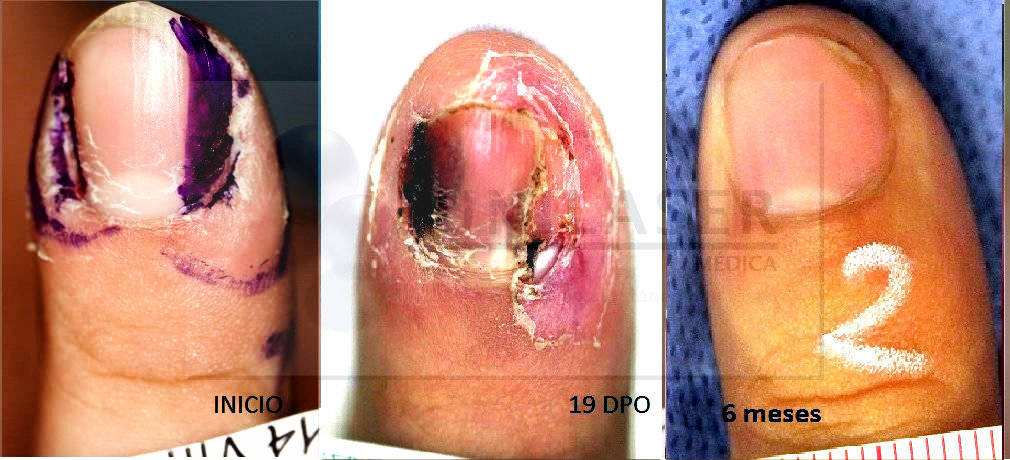
Seguimiento posterior a vaporización de verruga periungueal extensa
Follow-up after vaporization of extensive periungual wart
Evolution of treatment in an extensive periungual lesion.
