
Laser Scar Treatment
Laser scar removal
Why do scars recur so often, and what can be done?
The treatment of scars with laser deserves some considerations:
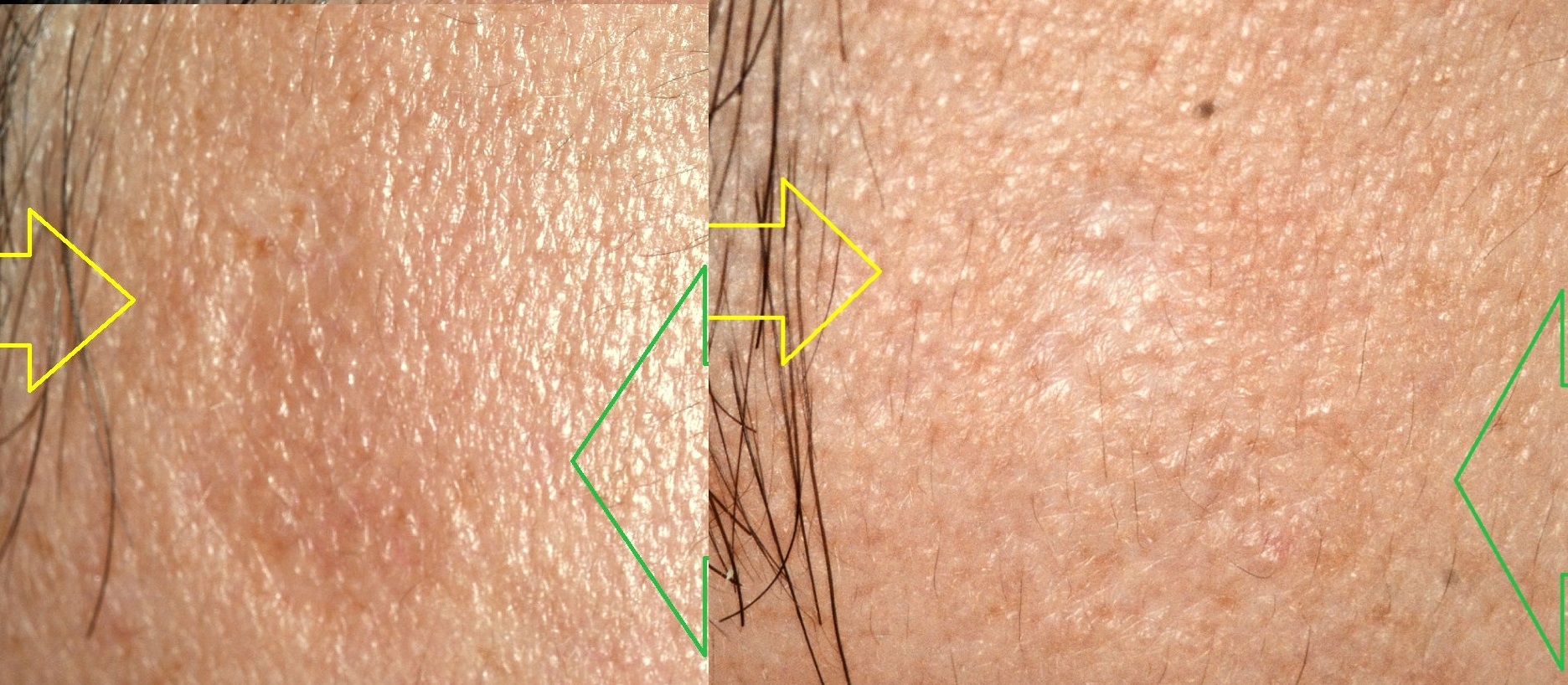
tratamiento cicatriz antigua facial acercamiento
- Old scars have gone through a “maturation” period in which growth activity disappears.
- The growth activity of recent scars is manifested by hardness, redness, symptoms, and mass.
- Old scars generally present varying degrees of atrophy.
- The goal of any treatment is to control the active part and improve the texture defect.
- Active scars are treated with sequential infiltrations until the activity disappears.
- The laser reduces redness and pigmentary changes.
- Fillers reduce and compensate for atrophic segments.
- Surgical revision is considered the most definitive option when feasible.
Which scars improve with laser?
Most of them. The exception is when the surgical alternative is faster and necessary.
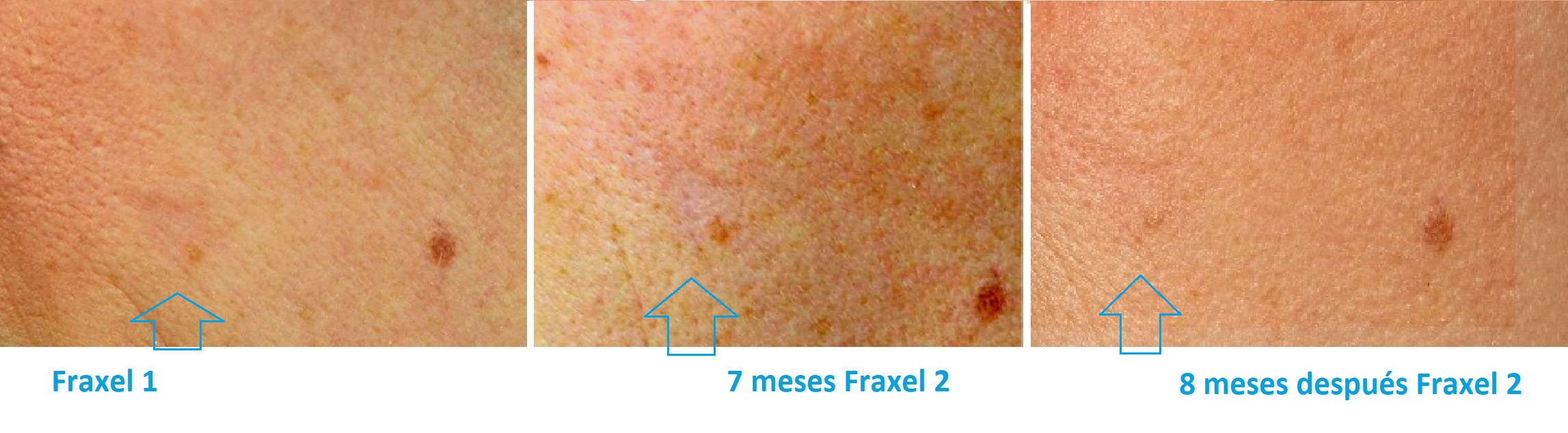
Scar remodeling by Fraxel laser
Reticular dermis growing after two Fraxel sessions
Progressive growth of the papillary dermis secondary to Fraxel laser stimulation.
What does the laser improve in scars?
It homogenizes pigment, reduces redness, and improves skin texture.
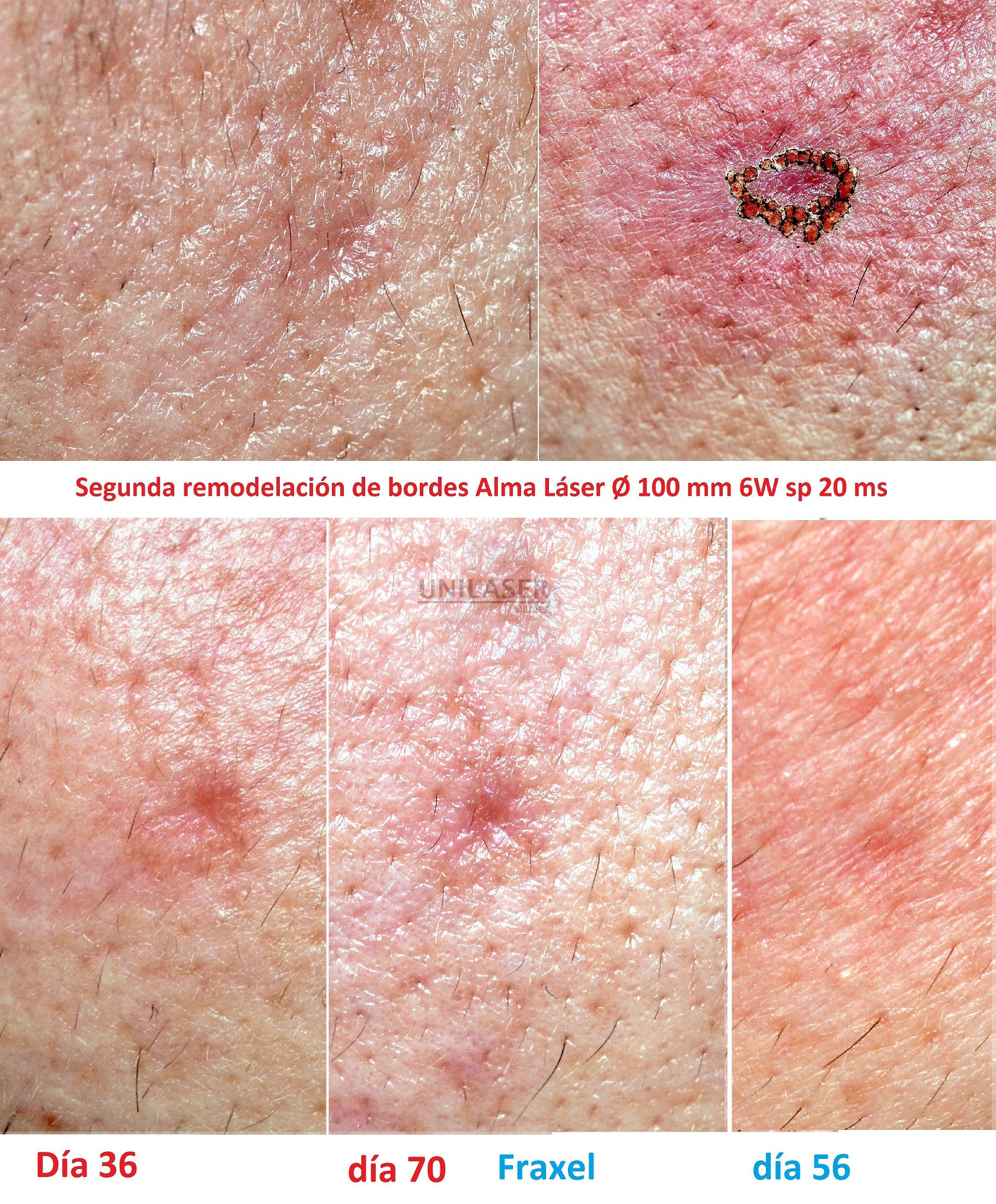
Resultado láser CO2 vs Fraxel cictriz atrófica – copia
Resultado de una segunda remodelación de bordes de una cicatriz en la mejilla con mal resultado estético a 70 días. Posterior a 56 días de utilizar el láser Fraxel se consigue disminución del enrojecimiento y nivelación
Result of a second edge remodeling of a cheek scar with poor aesthetic result at 70 days. After 56 days of using the Fraxel laser, a decrease in redness and leveling is achieved.
If I have a sunken scar, can it be improved?
Mild depressions respond to subablative lasers (Fraxel 1550). Depressions with very defined edges will need point or complete dermabrasions.
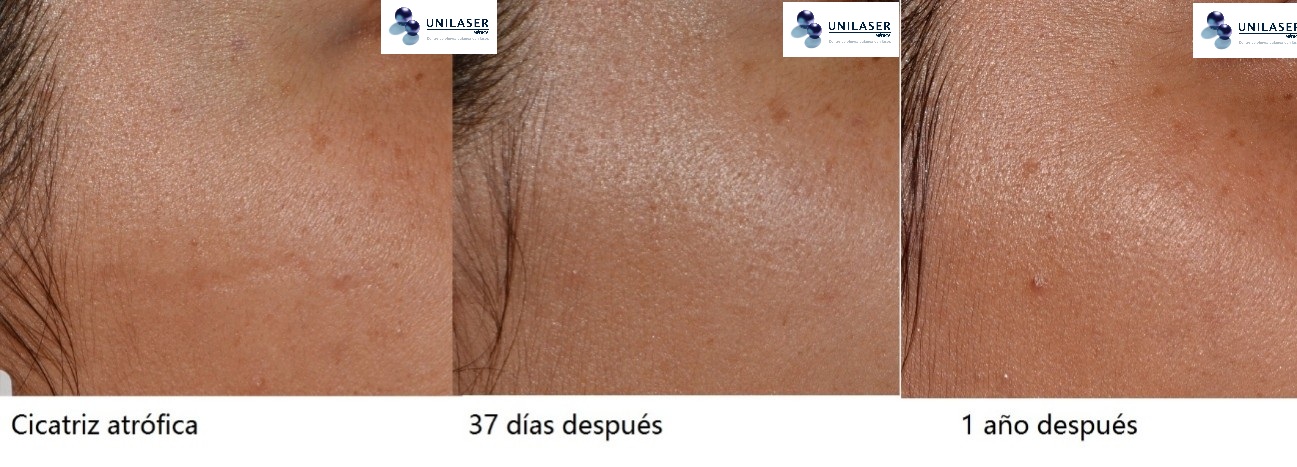
Eliminación de cicatriz atrófica con láser Fraxel
This case did not require leveling and responded to bed stimulation with the Fraxel laser. Changes at day 37 remained at 1-year control
This case did not require leveling and responded to bed stimulation with the Fraxel laser. Changes at day 37 remained at 1-year control.
¿Can red scars be improved?
The laser coagulates the scar vessels that give the red color to the scars.

20090922
Can thick scars be improved?
As long as they are not active, they can be vaporized with a CO2 laser. Scars that have thickened after surgical revisions and that have not responded to infiltrations can be improved by means of lasers.

Durante el primer año este caso no parecía tener respuesta visible. Una vez se alcanzaron los cubrimientos cercanos al 100 % se evidenció el control del exceso de fibrosis. Laser Fraxel 1550
During the first year this case did not seem to have a visible answer. Once coverage close to 100% was achieved, control of excess fibrosis was evident. Laser Fraxel 1550
How much do acne scars improve?
Scars with extreme changes in texture can be treated with combined leveling using Er:YAG, CO2, and Fraxel lasers. However, it is unlikely to recover a perfect texture.
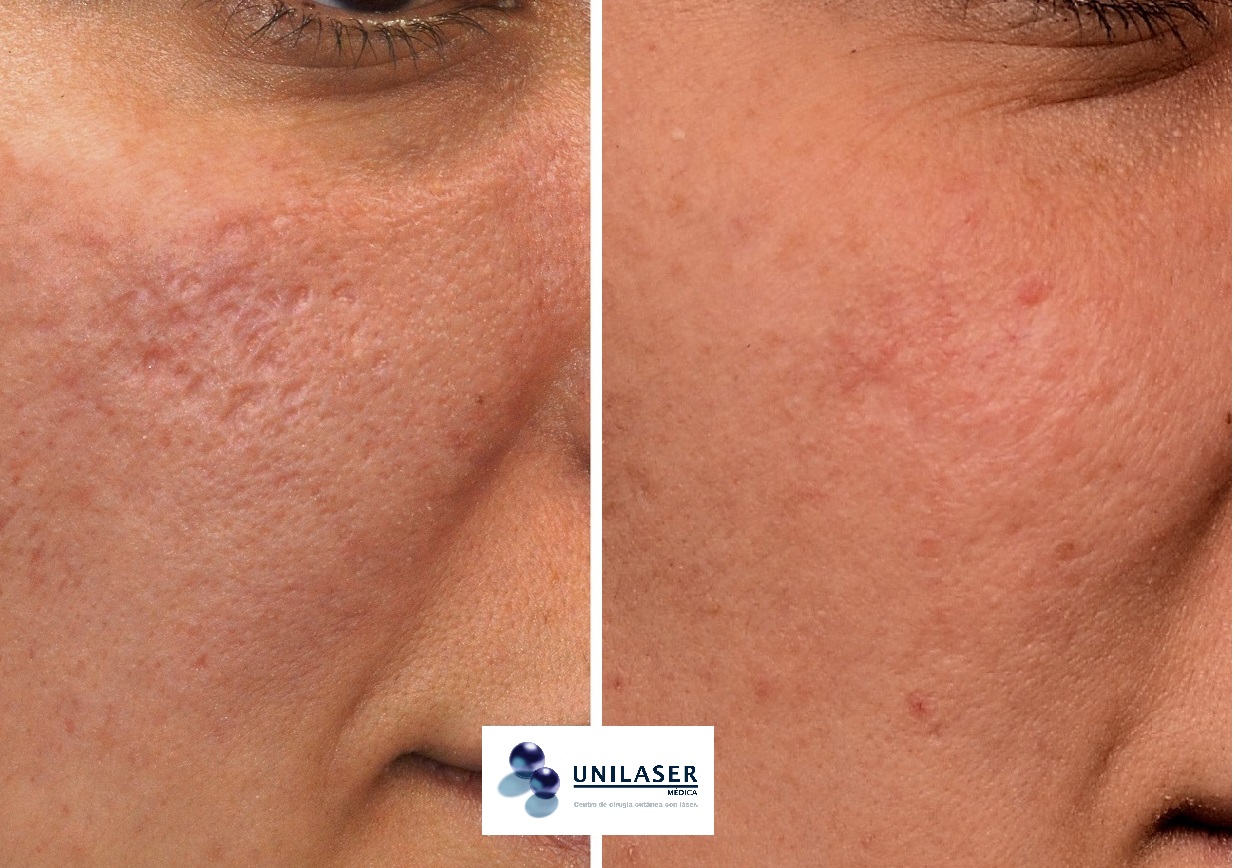
Respuesta a la nivelación con dermoabrasión láser y seguimiento con láseres fraccionados
Response to leveling with laser dermabrasion and follow-up with fractional lasers
How long does laser scar treatment take?
The pain generated by the laser is a consequence of the heat it produces. Lasers such as Erbio-YAG are well tolerated, as are pulsed-shot lasers. When the lesions are deep or extensive, prior infiltration with lidocaine is necessary.
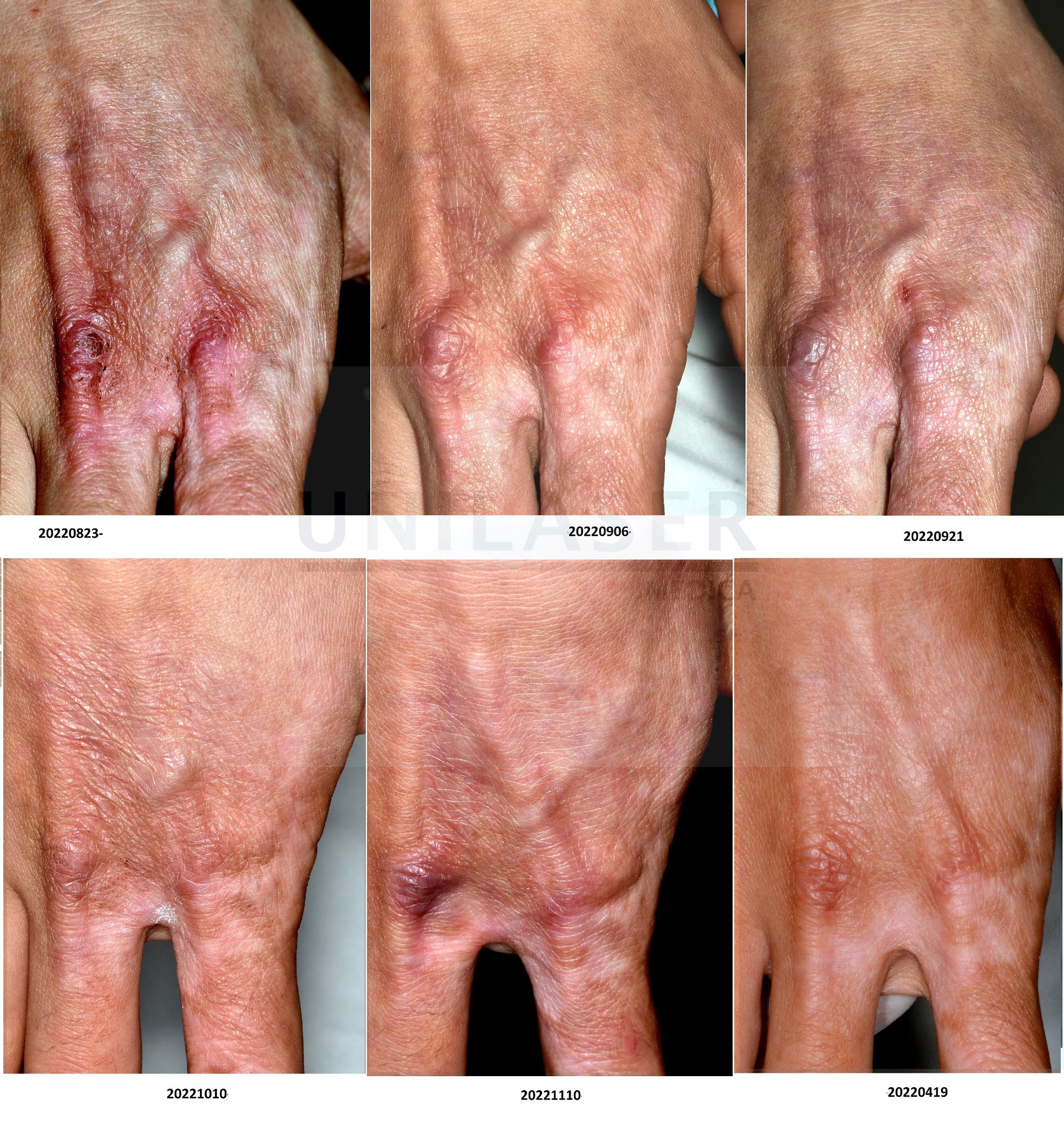
tratamiento mes 8 cicatriz dorso de la mano
The active hardening zones have been selectively infiltrated until controlled. Hyaluronic acid has been infiltrated into the atrophic part. Repigmentation has begun, a process that will take years to complete with sun exposure alone.
Can stretch marks be improved with laser?
The superficial ones do respond because there is material to reform the skin in the dermis.
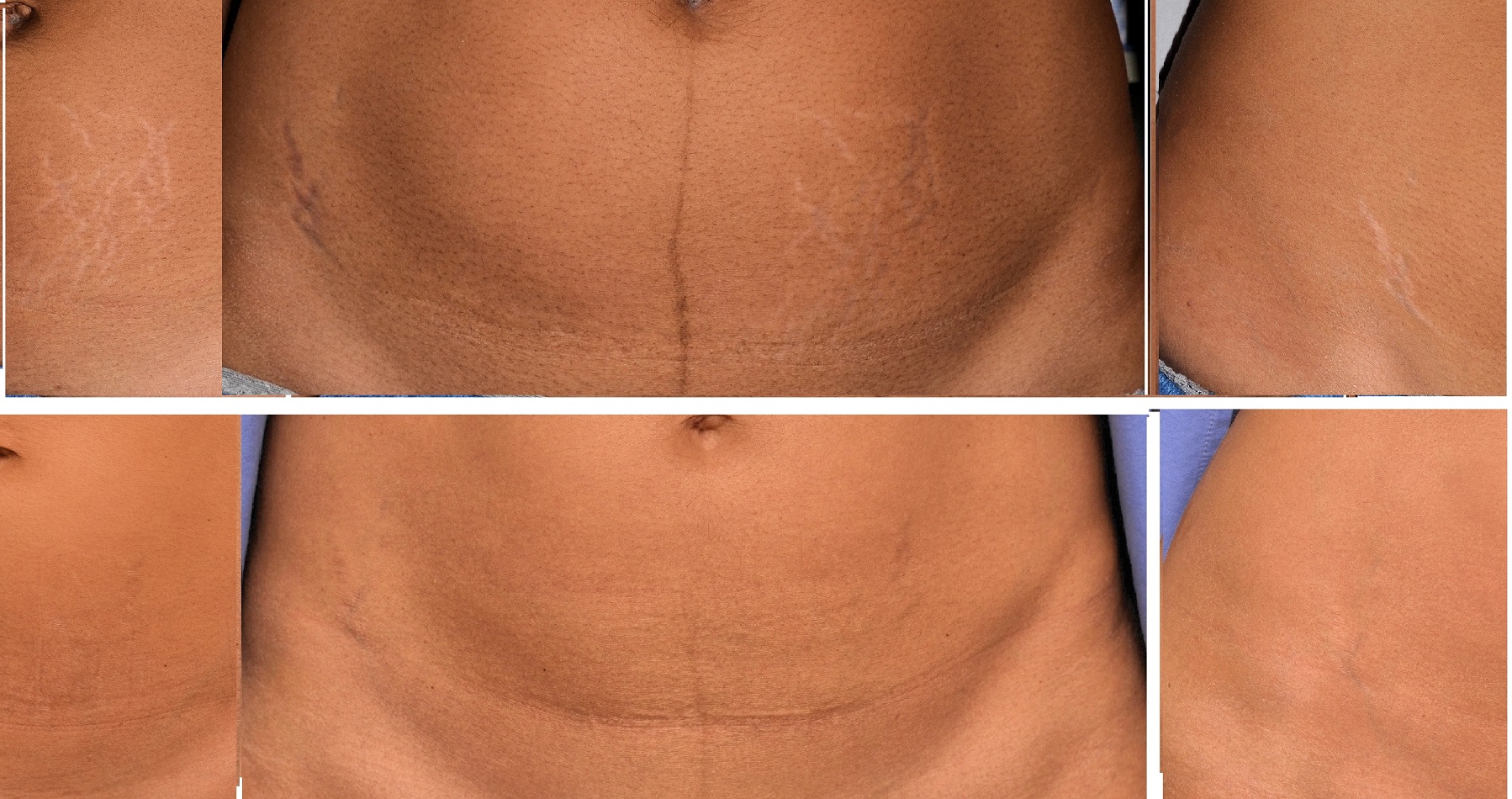
Nivelación conseguida con láser de CO2 fraccionado con técnica manual 8 meses posterior a una sesión.
Leveling achieved with fractionated CO2 laser with manual technique 8 months after a session.
